NetBlade
Android

Android 8.0 and later · On Google Play

The network toolkit that fits in your pocket.

NetBlade for Android scans your network, checks ports, analyzes Wi‑Fi channels and puts more than twenty-five sysadmin tools on your phone. It reads Windows PCs without installing anything on them, and it keeps an eye on your saved networks in the background. No account, no root, and your data stays on the phone.

Price
Freewith a banner

Advanced features: watch a video to unlock them for 24 hours, or make an in-app purchase that unlocks them and removes ads

NetBlade Android — LAN scanner: who is on the network NetBlade Android — Device details: what it is and what it exposes

Who it is for

Whoever looks after the home network

Cameras, NAS, smart TV, the kids' consoles: see who is connected, what each device exposes, and get told when something new joins.

The IT consultant on a site visit

Walk into a client's office with the phone, scan the LAN, check the ports of the suspect box, open an SSH session or read a Windows PC's inventory on the spot.

The small office that wants to know

Which PC has no antivirus, which program has a known flaw, which Wi‑Fi channel is crowded: answers without buying a server or hiring a department.

Screen by screen

A tour of the app

Real screens from the app, tab by tab.

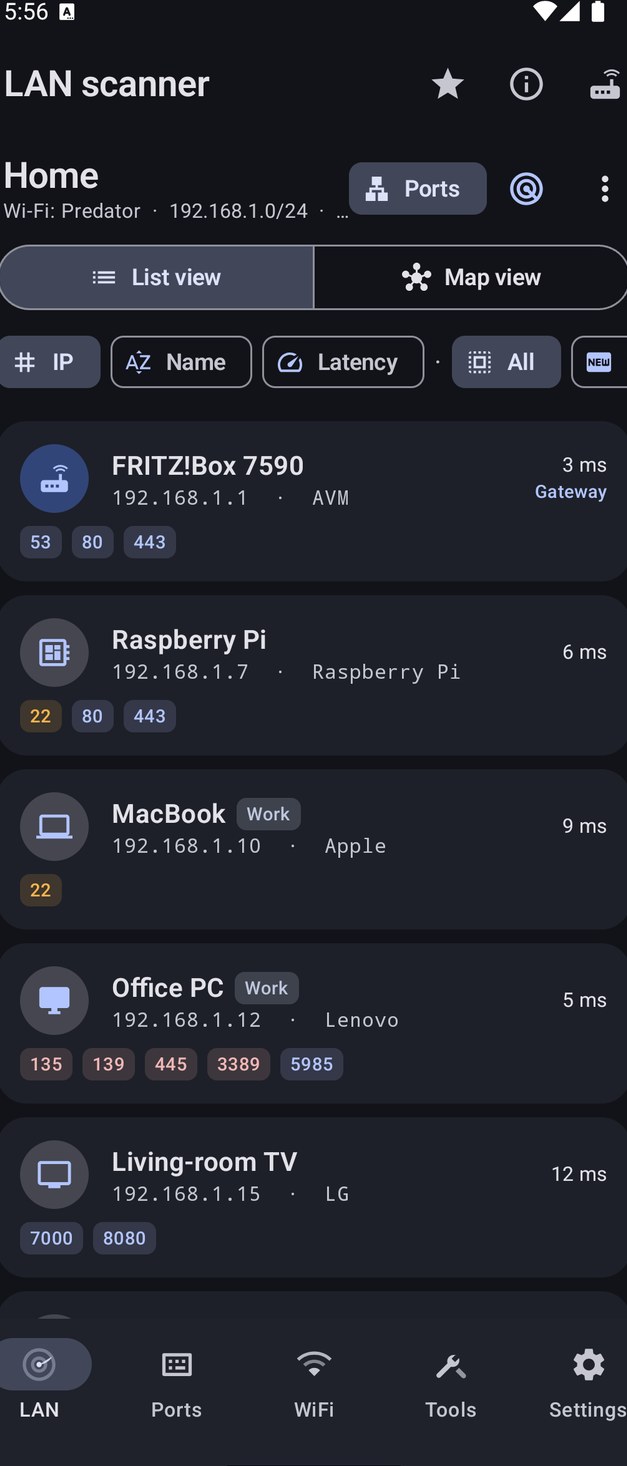
NetBlade Android — LAN scanner: who is on the network
01

LAN scanner: who is on the network

Every device that answers, with name, IP, vendor and latency, the gateway marked as such, and open ports as pills coloured by risk. Named networks remember their devices, and your own tags («Work») sit next to the name.

  • Sort by IP, name or latency; filter all, new or with open ports
  • Switch between list view and map view
  • Vendors from a built-in database of about 40,000 MAC prefixes, offline
NetBlade Android — Device details: what it is and what it exposes
02

Device details: what it is and what it exposes

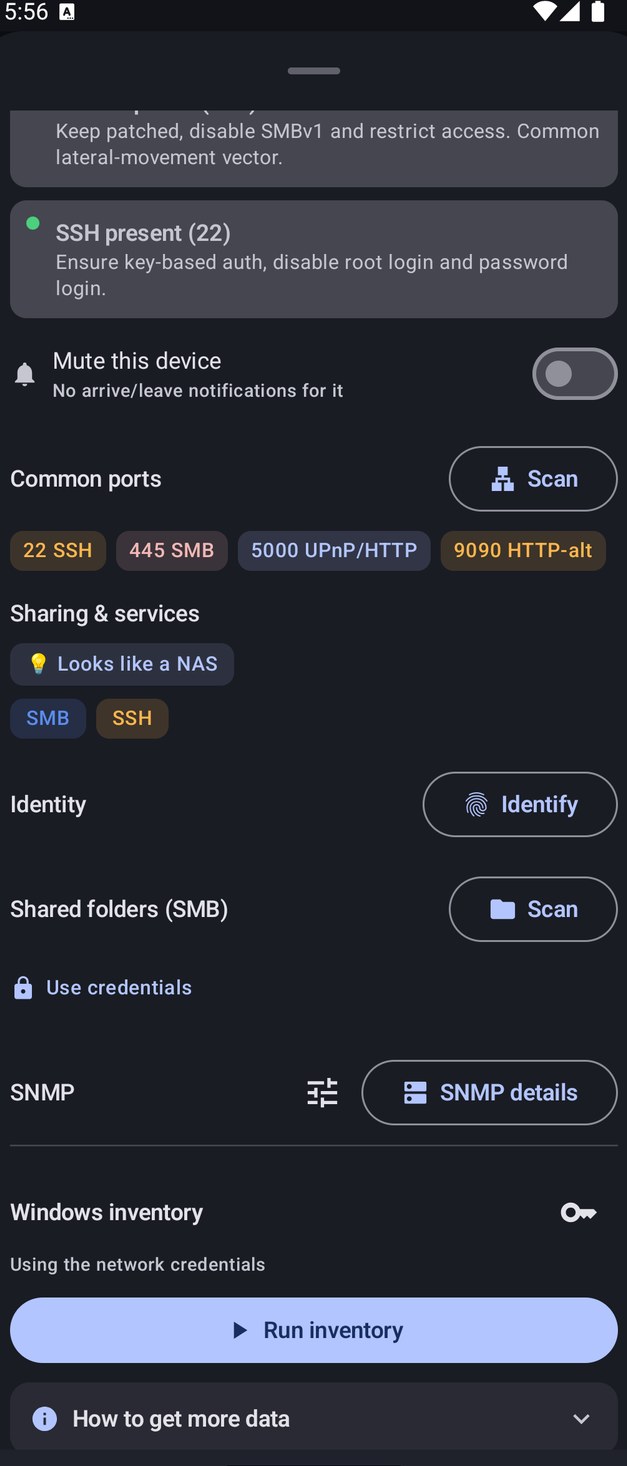
Each finding explains the risk and what to do: SMB to restrict, SSH to lock down with keys. Below come the common ports, the services the device announces with a guess at what it is («Looks like a NAS»), its identity, its shared folders, SNMP details and the Windows inventory.

  • «Identify» asks for NetBIOS name, workgroup and web server without sending anything off the phone
  • «Mute this device» silences its join and leave notifications
  • Every open port has «Connect»: browser, built-in SSH, or a suitable app
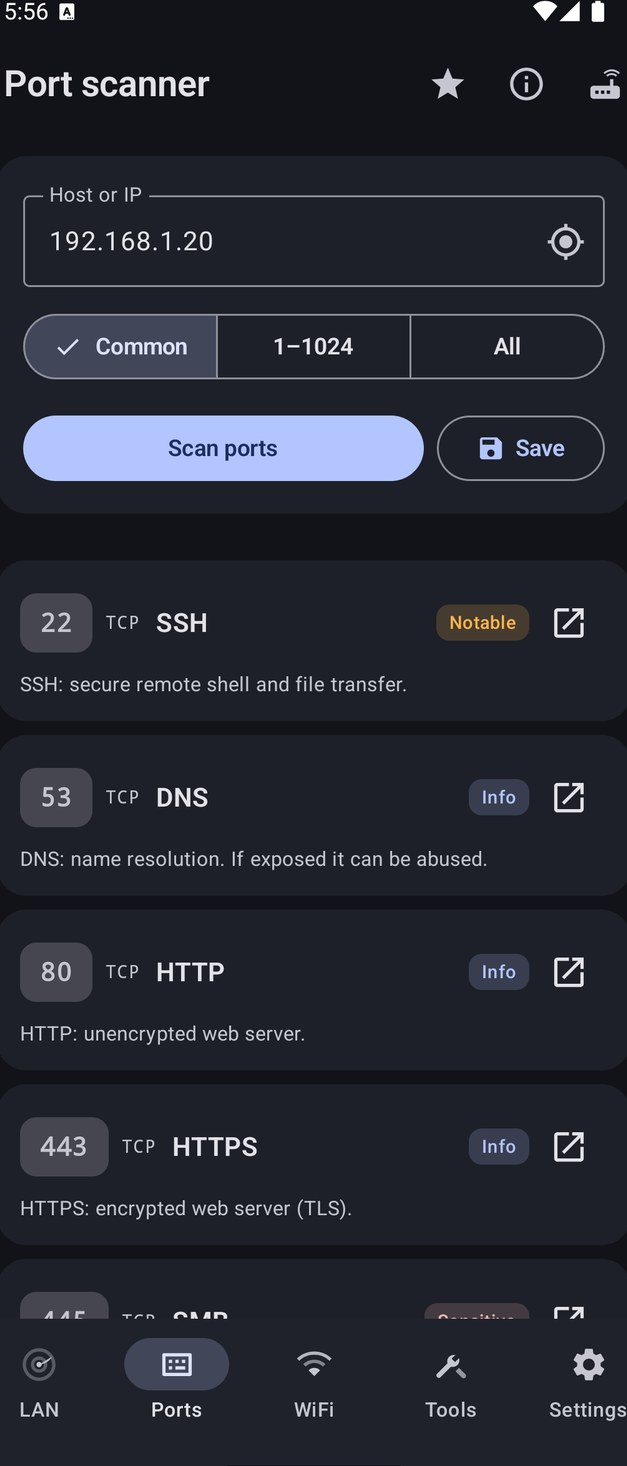
NetBlade Android — Port scanner: any host, even outside your network
03

Port scanner: any host, even outside your network

Type a host or use the gateway, choose the common ports, 1–1024 or all of them, and read each open port with its service, a plain-language description and a risk level: Sensitive, Notable or Info. Results can be saved.

  • Service greetings read where the service sends one
  • UDP services confirmed with specific probes: DNS, TFTP, NTP, NetBIOS, SNMP, SSDP, mDNS
  • «Search CVE» on a detected version opens NVD in the browser
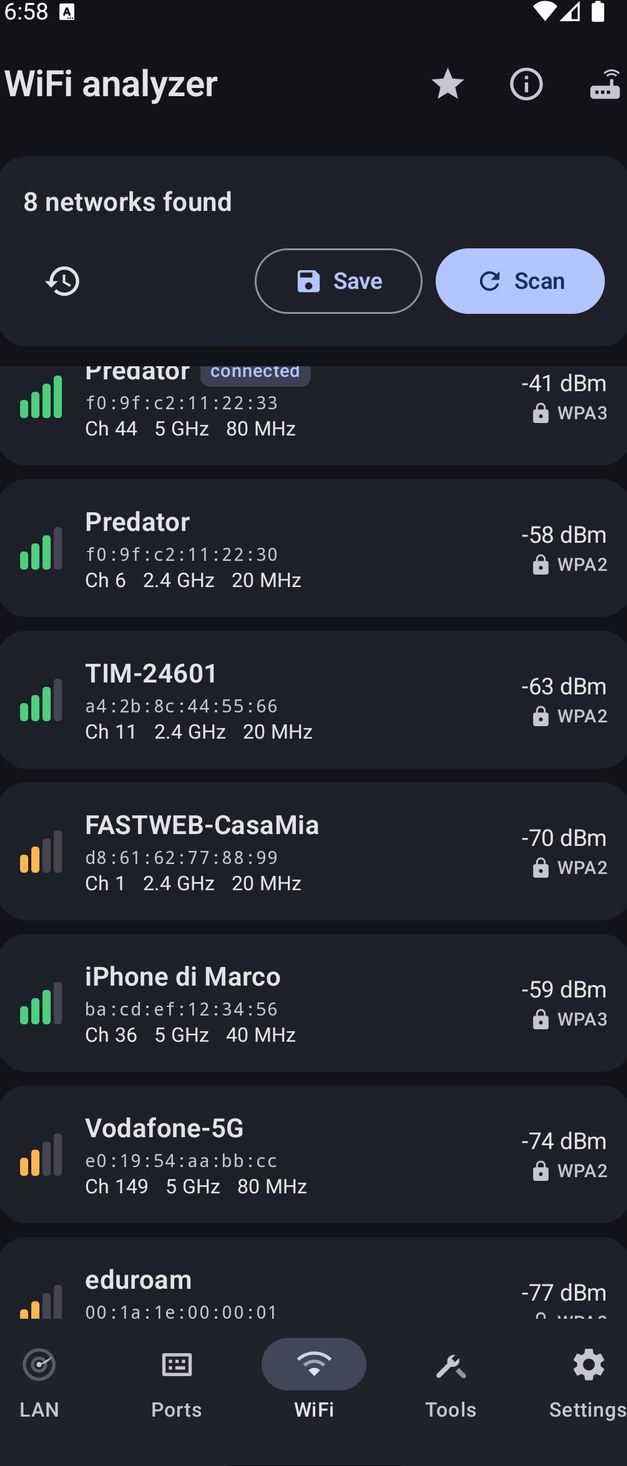
NetBlade Android — Wi‑Fi analyzer: the air around you
04

Wi‑Fi analyzer: the air around you

Nearby networks with name, BSSID, channel, band, channel width, signal in dBm and security from Open to WPA3, with the one you are connected to highlighted. Scans can be saved with the place where you ran them.

  • Channel usage charts for 2.4 and 5 GHz
  • A channel recommendation: the least busy one, or «already optimal»
  • History to compare an office before and after a change
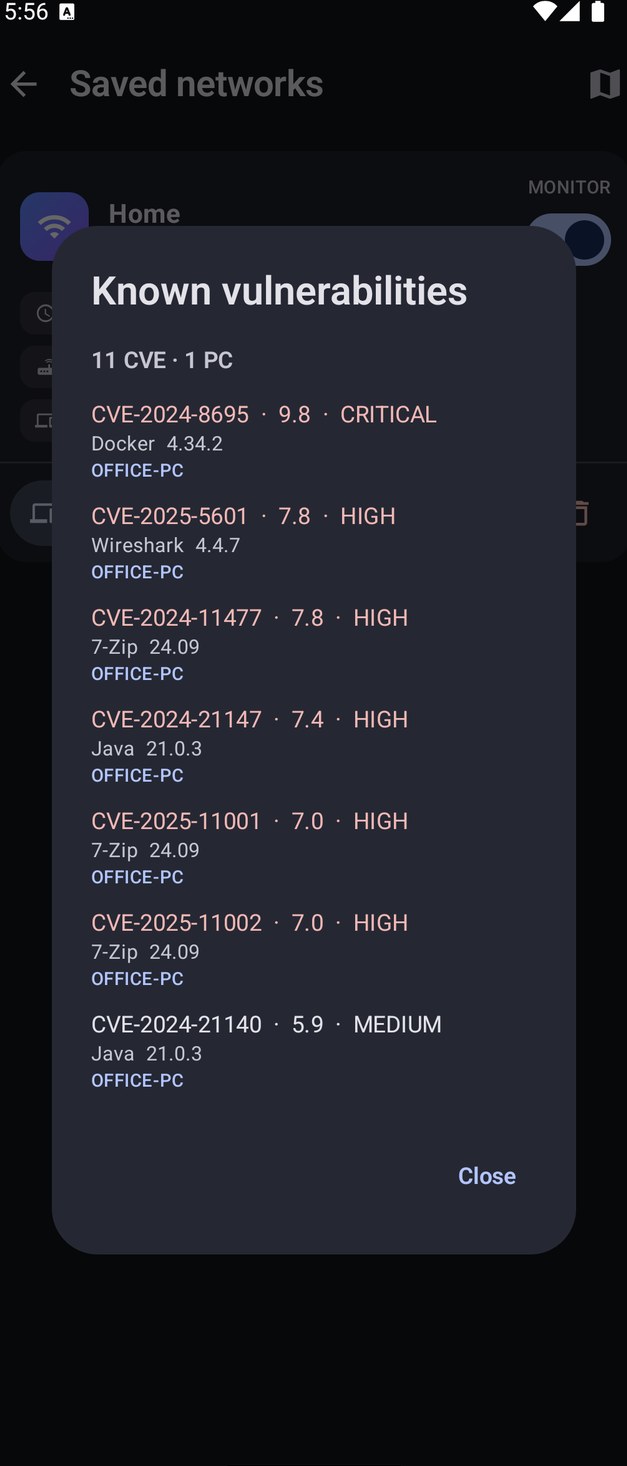
NetBlade Android — Known vulnerabilities across a saved network
05

Known vulnerabilities across a saved network

The saved network sums up what its PCs carry: how many CVEs on how many PCs, then each one with score, severity, program, version and the machine it sits on, worst first.

  • About seventy widely used programs checked by exact version, never by keyword
  • Only the name and version of recognised programs leave the phone, after your consent
  • Answers cached for a week
NetBlade Android — A Windows PC's defences and flaws
06

A Windows PC's defences and flaws

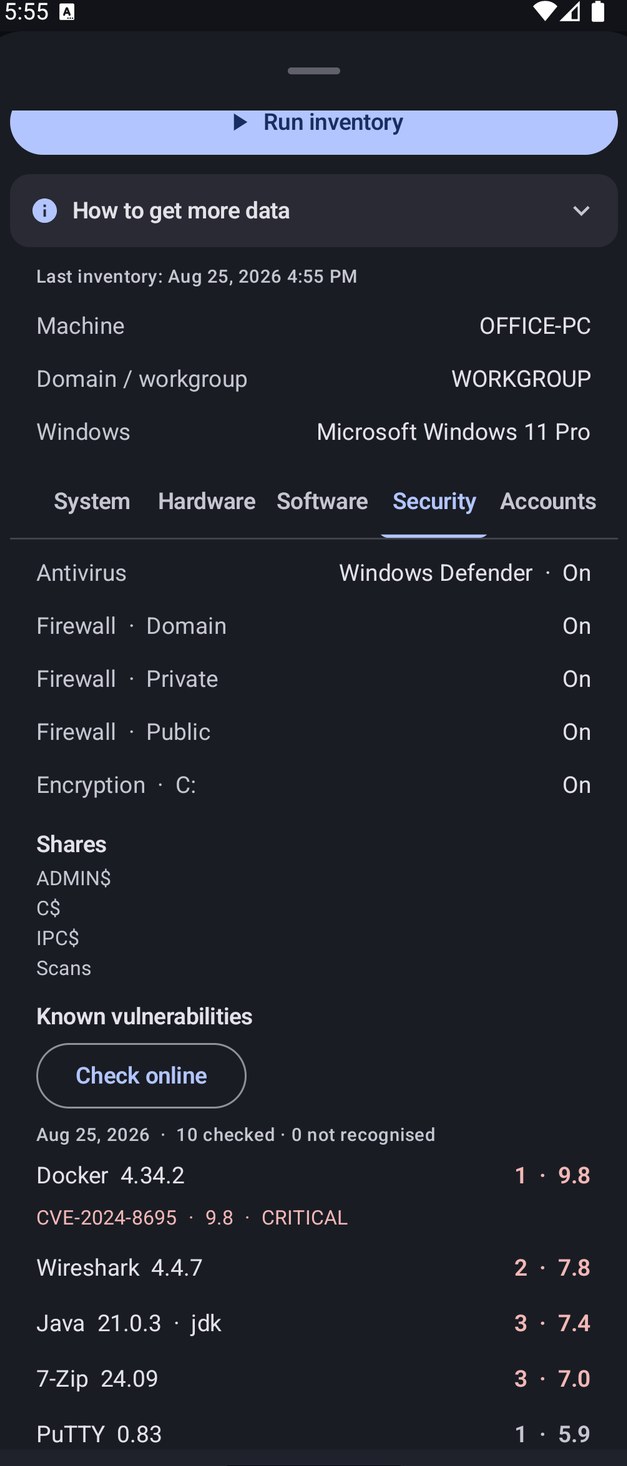
The inventory's Security tab shows the antivirus, the firewall per profile, disk encryption and the shares; under it, «Known vulnerabilities» lists each program with its CVE count and worst score, with an honest tally of how many were checked and how many were not recognised.

  • Antivirus, firewall, BitLocker and TPM read over WinRM
  • «Check online» asks NVD for the exact version of each recognised program
  • Never rounded up to «all clear»
NetBlade Android — Windows inventory, with nothing installed on the PC
07

Windows inventory, with nothing installed on the PC

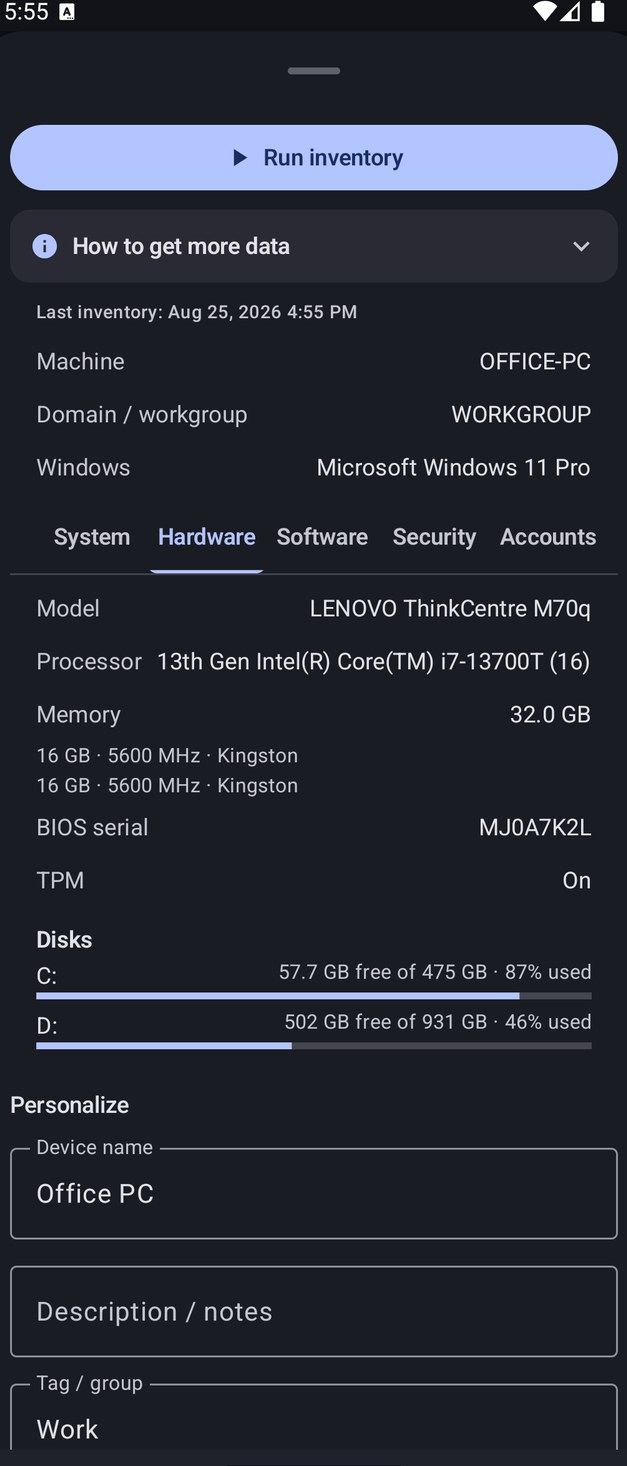
With a local administrator's credentials NetBlade reads the PC over file sharing and WinRM. The Hardware tab shows model, processor, memory modules, BIOS serial, TPM and disks with their free space; System, Software, Security and Accounts sit beside it.

  • Program versions read from inside the executable
  • «How to get more data» shows the commands to run on the PC; NetBlade does not run them for you
  • Scheduled inventory every 6, 12 or 24 hours on a saved network

What it does not do

  • Since Android 10 apps get limited access to the ARP table: some MACs stay «Not recovered» unless the router answers SNMP.
  • Background checks follow Android's battery rules and may arrive late; alerts and scheduled inventory cover only the network the phone is connected to.
  • The port scanner uses ordinary TCP connections, because a SYN scan would need root; UDP covers seven specific services, not every port.
  • Seven advanced features need a video or the in-app purchase: Windows and Linux inventory, the vulnerability check, exporting saved scans, LAN threat scan, router security and SNMP details.
  • The SNMP community and credentials are stored unencrypted in the app's database, and so end up in your Google account backup.

Questions about NetBlade for Android

Is it really free?

Yes, with a banner above the navigation bar. Scanning, ports, Wi‑Fi, SSH, file transfer, monitoring and almost every tool are free with no conditions. The advanced features unlock for 24 hours with a short video, or with an in-app purchase that also removes the ads.

Does it need root or an account?

No. Everything runs with ordinary app permissions, and each permission is asked for only when the feature that uses it opens. There is no account to create.

Why are some MAC addresses missing?

Since Android 10 the system limits apps' access to the ARP table. If your router supports SNMP, NetBlade can read its table, read-only, and recover the MACs and vendors Android hides.

Do I have to install anything on the PCs I read?

No. The Windows inventory uses a local administrator account over file sharing and, if it is enabled, WinRM. Linux machines are read over SSH with a read-only script shown to you before it runs.

Does my network data go anywhere?

No. Scans, devices and inventories stay in the app's database on your phone, and there is no server of ours. Outside services are contacted only when you use a tool that needs them, and the vulnerability check sends only the name and version of recognised programs, after your consent.

Does my purchase work on iPhone or Windows?

No. NetBlade for Android, for iPhone and iPad and for Windows are independent products: they do not sync and share no data, and each purchase is valid only on its own store. Your Google Play purchase follows your Google account on Android.

The network toolkit that fits in your pocket.

Step-by-step setup guides →